Core Requirements to OOP Languages
- Highly dynamic execution model
- Cooperating program parts with well defined interfaces
- Classification (hierarchy) and specialisation (reuse)
- Quality/Correctness
The Object Model
- A software system is a set of cooperating objects
- Objects have state (fields) and processing ability (methods)
- Objects exchange messages (methods)
Objects have:
- State
- Identity
- Lifecycle
- Location
- Behavior
Objects are different form values!
Values don’t have the above properties.
Interfaces and Encapsulation
- Objects have well-defined interfaces
- Publicly accessible fields
- Publicly accessible methods
- Implementation is hidden behind interface
- Encapsulation
- Information hiding
- Interfaces are the basis for describing behavior
Classification and Polymorphism
- Classification: Hierarchical structuring of objects (‘is-a’-Relation)
- Objects belong to different classes simultaneously
- Substitution principle: Subtype objects can be used wherever supertype objects are expected
Child <: Parent
Classification
- We can classify objects or fields (?)
- Classifications can be trees or DAGs
- Classifications of objects form “is-a” relation
- Classes can be abstract or concrete
Substitution Principle: Objects of subtypes can be used wherever
objects of supertypes are expected
Polymorphism
Subtype Polymorphism
- Direct consequence of substitution principle
- Run-time (dynamic) Polymorphism
- Dynamic (late) binding
Parametric Polymorphism
- Generic types
- Uses type parameters
- One implementation can be used for different types
- Type missmatch detected at compile time
- C++ Templates, Generics (Java, C#)
Method Overloading
- Ad-Hoc Polymorphism
- Overloading: Methods with same name but different arguments
Spezialization
- Start from general objects/types
- Extend these objecs (fields and methods)
- Behaviour of specialized objects need to be compliant to more general objects! (Substitution Principle)
- Progam parts that work for the genral objects work also for specialized objects
- Methods can be overridden
Types and Subtyping
Types
Type systems can be analyzed in three dimensions:
- Weak and Strong Type Systems
- Nominal and Structural Types
- Static and Dynamic Type Checking
Definition:
A type is a set of values sharing some properties. A value v has type T if v is an element of T.
T is a set that contains all possible values v.
Weak and Strong Type Systems
How strongly or weakly typed a language is concerns casting (implicit and explicit). It’s mainly used to compare languages to each other about the possible castings, type safety and information loss.
Untyped Languages
- Not classifying values into types, just bit patterns
- i.e. Assembler
Weakly Typed Languages
- Classifying values into types
- No strict enforcement of restrictions, i.e Multiplying two pointers is possible
- i.e. C, C++
Strongly Typed Languages
- Classify values into types
- Enforcing that all operations are applied to values of appropriate type
- Strongly-typed languages prevent certain erroneous or undesirable program behavior
- i.e. Java, Python, Scala, Smalltalk, Eiffel, C#
- Most Dynamic Languages (i.e Python, JavaScript) are Strongly Typed
Nominal and Structural Types
Nominal Types
- Based on type names
- i.e. C++, Java, Eiffel, Scala
Structural Types
- Based on available methods and fields
- i.e. Python, Ruby, Smalltals
Type Checking
Type checking prevents certain errors in programm.
When happens the type checking?
- Static: Compile time
- Dynamic: Run time
Static Type Checking
- Types of variables and methods are declared explicitly or inferred
- Types of expressions can be derived from the types of their constituents
- Type rules are used at compile time to check whether a program is correctly typed
A programming language is called type-safe if its design prevents type errors
Pros:
- Static safety
- Readability (type annotations are a good documentation)
- Efficiency
Dynamic Type Checking
- Variables, methods, and expressions of a program are typically not typed (types not declared)
- Every object and value has a type
- Run-time system checks that operations are applied to expected arguments
- Also static languages need to performe some checks dynamically at run-time (i.e type-casting)
- Dynamic languages are usually more expressive (no type annotations)
Pros:
- Expressiveness
- Low overhead (no type annotations)
- Much simpler
Overview of Type Systems in OO-Languages
| Static | Dynamic | |
|---|---|---|
| Nominal | C++, Java, Eiffel, Scala, C# | certain features of statically-typed languages |
| Structural | Research languages: O’Caml, Moby… | Python, JavaScript, Ruby, Smalltalk |
Dynamic and Structural is often called “duck typing”.
Subtyping
Substitution principle Objects of subtypes can be used wherever objects of supertypes are expected
- Syntactic classification: Subtypes understand at least the messages of their supertypes.
- Nominal languages: Subtype has a wider (or same) interface as supertype
- Overriding methods must not be less accessible
- Semantic classification: Subtypes provide at least the behaviour of their supertypes.
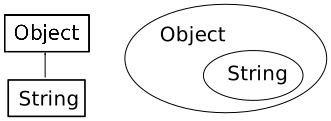
A type is a set of values. Subtype relation corresponds to subset relation.
- In nominal programming languages the programmer decides about subtype relation
- In structural programming languages the type checker decides about subtype relation
Variance (Covariance, Contravariance and Invariance)
Based on substitution principle.
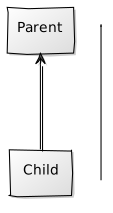
Covariance
Ordering of types from more specific to more generic (in direction of inheritance hierarchy)
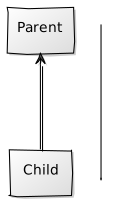
Contravariance
Ordering of types from more generic to more specific (in oposite direction of inheritance hierarchy)
Variance for OOP
| Variance | |
|---|---|
| Input Arguments | Contravariant |
| Return Values and Exceptions | Covariant |
| In- and Output Arguments (Mutable Reference Arguments) | Nonvariant |
SuperReturnType Super::foo(SubParamType p); // |         ^ contra-
//  ..                        ^             // |         | variant
//   v                        ..            // | co-     |
SubReturnType   Sub::foo(SuperParamType p); // v variant |
Super is more general than Sub.
Sub is more specific than Super.
| Programming Language | Return Type | Argument Type |
|---|---|---|
| C++, Java, Scala, D… | Covariant | Nonvariant |
| Eiffel | Covariant | Covariant |
| C# | Nonvariant | Nonvariant |
In Java and C# arrays are covariant!
Behavioral Subtyping (Contracts)
What are the properties shared by the values of a type?
Properties should also include the behavior of the object. This is expressed as interface specifications (contracts)
- Precondition: Have to hold before the method is executed
- Postcondition: Have to hold after the method has terminated
- Old-expressons: Can be used to refer to prestate values from the postcondition
- Invariant: Have to hold in all states in which an object can be accessed by other objects
Subtyping and Contracs
- Subtypes must fulfill contracts of supertypes
- Overriding method of subtypes may have weaker preconditions than the supertype method
- Overriding method of subtypes may have stronger postconditions than the supertype method
- Subtypes may have stronger invariants than supertypes
- Subtypes may have stronger history constrains than supertype
Specification Inheritance (Inherit Contracts from Subtypes)
- Subtype needs to satisfy the contract of the supertype (inheriting contracts)
- Invariant inheritance: Conjunction (AND) of own contract and contracts of all supertypes
- History inheritance: same as for invariants
- Precondition inheritance: Disjunctions (OR) of own contract and contracts of all supertypes
- Postcondition inheritance: Satisfy each postcondition for which the corresponding precondition holds
- Precondition needs to be evaluated with old state
Types as Contracts
Types can be seen as a kind of contracts.
Overriding Methods must:
| Behavioral Subtyping (contracts) | Nominal/Structural Subtyping (variance) |
|---|---|
| Weaker Preconditions | Covariant Parameters |
| Stronger Postconditions | Covariant Results |
| Stronger Invariants | Invariant fields |
This doesn’t apply exactly to:
- Invariants/Fields
- History constraints
Inheritance
Difference between inheritance and subtyping
Inheritance allows to reuse the code (specialization) inside a class (member variables and method definitions).
Subtyping supports reuse externally. It’s used for polymorphism in form of the substitution principle.
Subtyping expresses classification.
Subtypeing depends only on the interface of objects and not on their implementations.
In most existing OOP languages inheritance also is subtyping. C++ allows private (or protected) inheritance which does not result in subtyping. With interfaces (Java, C++…) it’s possible to create subtypes without inheritance (no reuse of code from parent class). Usually the term “inherit from an interface” is used even if it’s not correct.
Subclassing = Subtyping + Inheritance
Inheritance is not a core concept of OOP.
OOP can do without inheritance, but not without subtyping!
Aggregation vs. Private Inheritance (C++)
- Both solutions allow code reuse without establishing a subtype relation
- No subtype polymorphism
- No behavioral subtyping equirements
Aggregation causes more overhead
- Two objects at run-time
- Boilerplate code for delegation
- Access methods for protected fields
Private inheritance may lead to unnecessary multiple inheritance
Static and Dynamic Method Binding
- Static binding: Methods are selected based on the static type of the
receiver at compile time
- Dynamic binding: Methods are selected based on the dynamic type of the
receiver object at run time
Dynamic method binding enables specialization and subtype polymorphism
Drawbacks
- Performance: Overhead of method look-up at run-time
- Versioning: Dynamic binding makes it harder to evolve code
without breaking subclasses
Defaults
- Dynamic binding: Eiffel, Java, Scala, dynamically-typed languages
- Static binding: C++, C#
Static Method binding in Java
Java binds methods statically in 3 cases:
- Static Methods
- Private Methods
- Method calls on
super
Rules for proper Subclassing
- Use subclassing only if there is an ‘is-a’ relation
- Syntactic and behavioral subtypes
- Do not rely on implementation details
- Use precise documentation (contracts where possible)
- When evolving superclasses, do not mess around with dynamically-bound methods
- Do not add or remove calls, or change order of calls
- Do not specialize superclasses that are expected to change often
Binary Methods
Binary methods take one explicit argument and receiver (this)
Often behavior should be specialized depending on the dynamic types of both arguments.
Recall that covariant parameter types are not statically type-safe! (?)
- Dynamic binding for specialization based on dynamic type of receiver
- How to specialize on the dynamic type of the explicit argument?
- Visitor Pattern: tedious to write, requires modification of superclass
Some Languages Support Multiple Dispatch:
Method calls are bound on dynamic types of several arguments.
- Performance overhead
- Extra requirements are needed to ensure there is a “unique best method” for every call
Multiple Inheritance
All OOP languages support multiple subtyping:
- One type can have several supertypes
- Subtype relation forms a DAG
Some languages support multiple inheritance.
Problems with multiple inheritance
Ambiguities:
- Superclasses may contain fields and methods with identical names and signatures
- Which version should be available in the subclass?
Repeated inheritance (diamonds):
- A class may inherit from a superclass more than once
- How many copies of the superclass members are there?
- How are the superclass fields initialized?
Mixins and Traits
TODO
…
Parametric Polymorphism
Java, C#, …
- Subtype relation not always desiderable
- Generics (Java, Scala, C#)
- Upper bounds (
extends): Subtype of upper bound required- Guarantees that a specific method can be called
- Modular check of implementation of Generic code
- Generics (in Java, C#) are non-variant
- Covariance is unsafe when client writes to generic type argument (‘input’)
- Mutable fields
- Method arguments
- Contravariance is unsafe when client reads from generic type argument (‘output’)
- Fields
- Method results
- Non-variance is sometimes too restrictive
- Covariance is unsafe when client writes to generic type argument (‘input’)
- Scala allows variance-annotation
- Positive positions (‘output’, covariant):
+- Result type
- Type of immutable fields
- Negative positions (‘input’, contravariant):
-- Parameter type
- C# uses keywords
inandout
- Positive positions (‘output’, covariant):
- Methods can also have type arguments (i.e
static <T> void printAll(Collection<T> c) {...})
Wildcards
Wildcards can be seen as an Existential Type:
static void printAll(Collection<?> c) {
    for (Object e : c) {System.out.println(e);
    }
}
There exits a type argument
Tsuch thatchas typecollection<T>
-
Wildcards can have a upper bounds and lower bounds (correspond to co- and contravariance)
- upper bound for reading and method invocation:
extends - lower bound writing:
super
- upper bound for reading and method invocation:
-
lower bounds are not supported on type parameters (only on wildcards) in Java
Instantiation of wildcards can change over time:
class Wrapper {
    Cell<?> data;
}
// client code:
Wrapper w = new Wrapper();
w.data = new Cell<String>(); // w.data has type Cell<String>
w.data = new Call<Object>(); // now w.data has type Cell<Object>!-
Generics with wildcards (and possibly with bounds) have a subtype relation if the type parameters have a relation
-
Type Erasure (Java, Scala)
- For backwards compatibility (in JVM)
- Generic type information is erased in compiler (not available in bytecode anymore)
C<T>is translated toCTis translated to its upper bound- Casts are added wher nessecary (i.e reading values from generic type)
- Only one classfile and one class object for all instantiations of a generic class
- Run-time type information (
instanceof,List<String>.class) is missing - Arrays of generic types are not possible (
new List<String>[10]) - Static fields are shared by all instantiations of a generic class
- Lower bounds for type parameters would require support in JVM (bytecode verification)
-
No Type Erasure in C#
- Run-type type information is available
- Arrays of generic types are possible
C++ Templates
- Classes and Methods (Functions) can be parametrized
- Also value types can be used as templates paramters
- Instantiation generates (internally) a new class
- Type checking is done on of the generated class, not on the template (different to Java, C#, …)
- Type check only of the parts of code that are used
- Type errors are not detectes before instantination
- No bounds needed
- No subtype releation between instantiations of a template
- No run-time support needed (templates are a compilation concept)
- Templates can be specialized
- Improvement for feature C++ standard (C++17): Concepts Lite
- Structural upper bounds (C++ type system is nominal)
- Template Meta Programming
- Is touring-complete!
Information Hiding and Encapsulation
In the literature Information Hiding and Encapsulation are often used synonymously. But they are distinct but related.
Information Hiding
Information hiding is used to reduce dependencies between modules. The client is provided only the information needed.
- Concerns static parts of program (code)
- Syntactic and semantic: Contracts are part of the exported interfaces
- Reduce dependencies
- Classes can be studied in isolation
- Classes only interact in well-defined ways
Client Interface of a Class
- Class Name
- Type parameters (Generics) and their bounds
- Super-interfaces
- Signatures of exported methonds and fields
- Client interface of direct superclass
Other Interfaces
- Subclass interface (i.e
protected) - Friend interface (
friendin C++, default access in Java) - Inner classes
- …
Java Access Modifiers
public: client interfaceprotected: subclass and friend interface- default access: friend interface
private: implementation
| Modifier | Class | Package | Subclass | World |
|---|---|---|---|---|
public | Yes | Yes | Yes | Yes |
protected | Yes | Yes | Yes | No |
| ’default’ | Yes | Yes | No | No |
private | Yes | No | No | No |
Safe Changes
- Renaming of hidden elements
- Modification of hidden implementation (functionally needs to be preserved)
- Access modifiers specify what classes might be affected by a change
Exchanging Implementation
- Behaviour needs to be preserved
- Exported fields limit modification
- Use getters and setters
- Uniform access (Eiffel, Scala)
- Modification is critical: Fragile baseclass problem!
- Object structures
Bug: Method Selection in Java
-
Bug was present in JSL1. It’s fixed now!
-
Compile time:
- Determin static declaration (find the method in the receiver class, method can be inherited)
- Check accessibility
- Determine invocation mode (virtual / non-virtual)
-
At run-time: 4. Compute receiver reference 5. Locate method to invoke (based on dynamic type of receiver object) that overwrites
-
Rules for overriding
- Access modifier of overriding method must provide at least as much access as the overridden method
- default access →
protected→public privatemethods can’t be overridden: Hiding
Encapsulation
Encapsulation is used to guarantee that data and structural consistency by capsules with well defined interfaces.
-
Data consistency: i.e value is not negatice, …
-
Structural consistency: i.e tree is balanced, list is doubly linked, …
-
Concerns dynamic parts of code (execution)
-
Context of a module can be changed but module behaves same
Levels of Encapsulation
Capsules can be:
- Individual objects
- Object structures: i.e doubly-linked list
- A class (with all its objects): i.e all threads in Java
- All classes of a subtype hierarchy
- A package with all of its classes and their objects)
- Several packages
Internal representation of capsule that needs to be proteced:
- invariant
- or history constraint
Hiding fields are useful for:
- Information Hiding
- Encapsulation
Achieving Consistency of Objects
- Apply information hiding wherever possible
- Make consistency criteria explicit
- Contracts
- Informal documentation
- Check interfaces (also subclass methods, i.e
protected)- Make sure they preserve documented consistency criteria
Object Structures
An object structure is a set of objects that are connected via references.
Examples
- Array-Based Lists
- Doubly-Linked Lists (
java.util)
Aliasing
-
A reference to memory location
- Aliasing occures if more than one variable allows access to the same memory location
-
Static/Dynamic Aliases
- Static alias: all involved variables are in the heap
- Dynamic aliasing: some involved variables are stack-allocated (others can be in the heap)
Intended Aliasing
- Efficiency
- Objects need not to be copied, when passed or modified
- Sharing
- Share the same object between different places
- Consequence of objects identity
Unintended Aliasing
Capturing
- Get a reference from outside and store it
- Often in constructors that take reference arguments
Leaking
-
Passing a reference to an (internal) data structure to the outside
-
More frequent then capturing
Problems with Aliasing
- Aliases can be used to by-pass interface
- Interfaces and contracts remains unchanged but observable behaviour can change!
Consistency of Object Structures
- Consistency of object structures debend on several fields (not only one)
- Checking invariance on beginning and end of method is not enough
- State can be changed in between by an alias
Other Problems with Aliasing
- Synchronization in concurrent programs
- Lock protects data structure
- Locking a reference dosen’t lock aliases
- Distributed programming
- i.e Remote Method Invocation
- References (intended aliases) are lost
- Optimizations
- i.e Inlining is not possible for aliased objects
Alias Control in Java
LinkedList:
- All fields are
private Entryis private inner class ofLinkedList- References are not passed out
- Subclasses cannot manipulate or leak
Entryobjects
ListItris private inner class ofLinkedList- Interface
ListIteratorprovides controlled access toListItrobjects ListItrobjects are passed out in a controlled way- Subclasses cannot manipulate or lead
ListItrobjects
- Interface
- Subclassing is restricted!
String
- All fields are
private - References to internal char-array are not passed out
- Subclassing is prohibited (
final)
Readonly Types
- Restrict access to shared objects
- Common: grant read-only access
- Cloning can prevent aliasing in some cases (but is inefficient)
- The reference can be marked as readonly
- The object itself is not readonly
Requirements for Readonly Access
-
Mutable objects
- Only some clients can mutate object
- Access restrictions apply to references (not whole objects)
-
Prevent field updates, calls of mutating objects
-
Transitivity
-
Possible solution: wrap objects in readonly objects or use a readonly interface
- Not practical
- Not safe: no compiler checks, readwrite alias can still occur, …
Readonly access in C++ (
const) is not transitive
Pure Methods
Pure methods are side-effect free.
- Must not contain field updates
- Must not invoke non-pure methods
- Must not create objects (on heap)
- Can be only overridden by pure methods
- Stronger constraints than const methods in C++
Pure methods are very restrictive:
- Not possible to get an iterator (which is created on heap) to iterate over collection
- Caches can’t be implemented
- Lazy initialization is not possible
Readwrite and Readonly Types
- Concerns only reference type (object type is always mutable)
- Readwrite type:
T - Readonly type:
readonly T - Subtype relation:
T<:readonly T - Not same as relation between mutable and non-mutable types (which have no relation)
- Readonly is transitive
Transitivity of Readonly Types
The type of
- Field access
- Array access
- Method invocation
is determined by type combinator: ►
| ► | rw T | ro T |
|---|---|---|
| rw S | rw T | ro T |
| ro S | ro T | ro T |
Type Rules: Readonly Access
Readonly types can’t be receiver of:
- Field update
- Array update
- Invocation of pure method
Readonly types must not be cast to readwrite types.
- Leaking can be prevented
- Capturing can still occure
Ownership Types
Prevents capturing.
Object Topologies
Distinguish internal references from other references.
Roles in Object Structures
- Interface objects: used to access the structure
- Internal representation: must not be exposed to outside (clients)
- Arguments of the object structure: must not be modified by the structure (i.e entries in a list)
Ownership Model
- Each object has one (or zero) owner
- An object belongs to the internal representation of the owner
- Ownership relation is acyclic (forrest of ownership trees)
- Context: all objects that have the same owner
- Ownership relation is not transitive
Type Invariant:
The static ownership information (declared in code) reflects the run-time ownership of the referenced object
Ownership Types
- peer: in the same context, same owner as owner of this
- rep: references to objects owned by this (in the context of this)
- any: in any context (I don’t care)
- lost: specific owner but not known (I care but don’t know)
- self: only for the
thisliteral (special because ownership relative tothis)
lost and self are internal (hidden) type modifiers. No keywords.
Traversing hierarchy:
- rep: go down in herarchy
- peer: go across on same level in hierarchy
- any: jump somewhere, could even be outside of hierarchy
Type Safety
- RTTI contains:
- The class of each object
- The owner of each object
- Type invariant:
- static ownership reflects run-time owner
any and lost are extistential types.
any T o;There exitst an owner such that o ist an istance of T and has that owner.
Subtyp Relation between Ownership Types
rep types and peer types are subtypes of corresponsing any types.
- rep T <: any T
- peer T <: any T
Casts:
- any can be cast to rep or peer (with runtime checks)
Viewpoint Adaption
- Ownership relation is expressed relative to this.
- If this object (viewpoint) changes, the ownership changes.
- When creating an object the ownership has to be set
new rep Entry()new peer Entry()- any is not allowed for
new - Ownership can’t be changed later
| ► | peer T | rep T | any T |
|---|---|---|---|
| peer S | peer T | lost T | any T |
| rep S | rep T | lost T | any T |
| any S | lost T | lost T | any T |
| lost S | lost T | lost T | any T |
| self S | peer T | rep T | any T |

Field Access and Method Invocation (Type Rules)
: Type of a
Field Read or Method Parameters:
v = e.f;Is correctly typed if:
Field Write or Method Result:
e.f = v;And
is not lost.
Aliasing
- rep: internal representation
- no unwanted sharing
- leaking as rep: viewpoint-adaptation in client gets lost
- method argument rep
- capturing as rep: gets lost, can’t assign to lost
Example:
class Person {
  private rep Address addr; // part of internal representation
  public rep Address getAddr() {
    return addr; // clients get lost-reference
  }
  public void setAddr(rep Address a) {
    addr = a; // cannot be called by clients (lost) only by this bject
  }
  public void setAddr(any Address a) {
    addr = new rep Address(a); // cloning necessary, can't assign any to rep
  }
}
Owner-as-Modifier
-
Readonly Typesystem: leaking is safe (only readonly leaking)
-
Ownership Typesystem: capturing is safe (declaring internal references as rep)
- leaking can happen only as any or lost
-
Combining both Typesystem
-
any and lost: Readonly
Additional enforced rules:
- Field write
e.f = v;is valid only if is self, peer or rep - Method call
e.m(...);is valid only if is self, peer or rep, or called method is pure
A method can modify directly at most all the objects that have the same owner as
this. Everything further down in the hierarchy can only be changed indirectly (via method calls).
-
When debugging: if an object changes the changing method is going to be on the call stack
- Changing methods need to go through all the owners transitively
- Owner is like a gate keeper (interface object)
-
Stronger concept for encapsulation than private-protected-public
-
leaking only happens as readonly (‘something’ ► rep: lost)
-
Standard (Java): default modifier would be peer, flat datastructures
-
‘shared ownership’ is not possible. i.e List owns nodes and modifying Iterator would need readwrite access to nodes.
- List would need
-
The system can be combined with Generics:
rep List<peer Address> -
Also possible: merge entire contexts to new owner. i.e concat two lists.
Achievements
- Encapsulate whole object structures
- Can not be violated
- Subclassing is no restriction
- Invariants of object o can depend on:
- Encapsulated fields of o (as usual)
- Fields of objects transitively owned by o
Initialization and Null-References
- Main Usages of Null-References
- Terminate recursion, list, …
- Initialization (i.e lazy initialization)
- ‘Result not found’ as a return value of a function (absence of an object)
- Most (80%) of all variables in an OOP programm are non-null after initalization
- Real need for null value is rare
- Theoretical type system:
- Non-null tye:
T!(references toT-Object) - Possibly-null type:
T?(references toT-Object plus null) - Subtype relations (S <: T)
- S! <: T!
- S? <: T?
- T! <: T?
- Dereferencing only possible with non-null type (
T!) - Possible casts:
- Implicit: From non-null to possibly-null (
T! nn = ...; T? pn = nn;) - Downcasts (explicit) are possible but need run-time checks (
T? pn = ...; T! nn = (T!)pn;Shortcut for(T!):(!)) - Additional type rules (compared to Java): Expressions whose value gets dereferenced need non-null type
- Receiver of: field access, array access, method call
- Expressions of a
throwstatement
- Dataflow Analysis
- Check if a value at a given position in code can or can’t be null
- Tracks values of local variables but not of objects on the heap
- Tracking heap locations is non-moduler
- Other threads could modify heap locations
- Implicit: From non-null to possibly-null (
- Non-null tye:
Object Initialization
- All fields are initialized to null (Java, C#, …)
- Invariant of non-null types is violated at beginning of constructor (it’s initialized to
nullby default)- Make sure that all non-null fields are initialized when constructor terminates
- Similar to Definite Assignment Rule that check that local variables are assigned before first use (Java, C#)
- Needes checks:
- Dereferces
- non-null fields have non-null types
- non-null arguments are passed non-null method parameters
- Not possible to check for all cases: escaping the constructor
- The simple Definite Assignement Rule is only sound if partly-initialized object do not escape from constructor
- Overly restrictive: on partly-initialzed objects
- Dont call methods
- Don’t pass as argument to methods
- Dont’s store in fields or an array
- Better type-system: track initialization (construction types)
- Initialization Phases (3 types per class/interface)
- free type: objects under construction (free to violate invariants, free to have null in non-null variables)
- committed type: object construction is completed (type of object is chaged at run-time when object is fully constructed)
- unclassified type: super-type of free type and committed type
- Initialization Phases (3 types per class/interface)
- Make sure that all non-null fields are initialized when constructor terminates
Type Invariant:
An object is initialized if all fields have non-null values (transitively).
There could also be other invariants that have to hold after object is initialized, but can be broken before the object is fully initialized.
Type Rules
- Most type rules of Java remain unchanged
- Additional requirement: dereferencing needs a non-null type
- Receiver of field access
- Receiver of array access
- Receiver of method call
- Expression of a
throwstatement
- Dereferencing of a non-null type can be checked statically (compile time)
- Escaping constructor is an issue
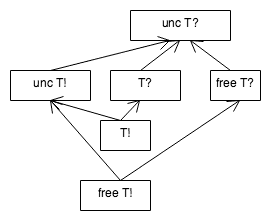
- Combining non-null type system with construction types
- 6 types
| non-null | possibly-null | |
|---|---|---|
| comitted | T! | T? |
| free | free T! | free T? |
| unclassified | unc T! | unc T? |
No downcasts from unclassified to free or committed (no reasonable run-time checks).
Local Initialization
- An object is locally initialized: all non-null fields have non-null values
- Static type committed: locally initialized at run-time
Field access:
e.f| Field access | f: ! | f: ? |
|---|---|---|
e: commited | ! | ? |
e: free | ? | ? |
e: unc | ? | ? |
Transitive Initialization
- Committed has to be transitive
- An object is transitively initialized if all reachable objecs are localy initialized
- static type committed: transitively initialized at run-time
Cyclic Structures
- In initialization code (i.e constructor) it’s allowed to assign committed types to fields of free types
Type Rules
- Field declaration has no consturction-type modifier
- non-null (
!) or possibly-null (?) modifiers are possible - It’s determined if it’s free or committed when dereferencing (
e.f) - Field declaration is the only place in a programm that has not construction-type modifier
- non-null (
- committed is transitive!
- It’s not allowed to have a committed and a free reference to the same object (no cross-type aliases)
- The free reference could assign a pointer in the object to an uninitialized field
- It’s critical when an reference changes from free to committed
Field Write
A field write
a.f = bis well-typed if
aandbare well-typeda’s type is a non-null type (!)b’s class and non-null type conforms toa.f- **
a’s type is free orb’s type is committed **
type of a \ type of b | committed | free | unc |
|---|---|---|---|
| committed | ✓ | ✘ | ✘ |
| free | ✓ | ✓ | ✓ |
| unc | ✓ | ✘ | ✘ |
Field Read
- A field read
e.fis well-typed if:eis well-typede’s type is a non-null type (!)- Field (
f) has no construction-type modifier
The type of e.f is:
| type of e \ type of f | T! | T? |
|---|---|---|
S! | T! | T? |
free S! | unc T? | unc T? |
unc S! | unc T? | unc T? |
Consturctors
- Constructor signatures: each parameter has declared construction-type (default: committed) and null-ness type
thisin cunstruction has implicitly: free non-null- Definite assignment check for complete constructor
- Constructors are free by default
- The most permessive type for arguments in a constructor declaration is unc
- This should be chosen if possible
Method Calls
- Method signatures: each parameter has declared construction-type (and null-ness type)
- Method signatures can contain construction-type for
this
Construction-type for this:
String! free getId(String! n) {
  return ...;
}- Overriding requires usual co- and contravariant rules
- The receiver (
this) counts as parameter - Method arguments should not be declared as unclassified if possible
- otherwise overriding methods need to cope with unclassified too
- The receiver (
Object Construction
- At the end of a constructor the object is not nessecary fully initialized (i.e constructors of deriving classes are not run yet)
- End of a
newexpression: constructed object might not yet be fully constructed newexpressions can have only references to committed objects outside of thenewexpression- committed reference to the
newexpression is not possiblenewnot yet finished (not committed, free)- But committed objects can’t have pointers to free
- committed reference to the
- Nested
newexpression:- if the ‘inner’
newexpression is fully (transitively) initialized reference to and from the outside - the ‘outer’
newexpression can point to the ‘inner’newexpression
- if the ‘inner’
new Expression
After ‘outer’
newexpression (only committed arguments) finishes all ‘inner’newexpressions have references to locally initialized objects. All references inside the ‘outer’newexpression point to transitively initialized objects.
- The type of a
newexpression is committed if the static types of all arguments of the constuctor are committed- Otherwise it’s free
- It’s not relevant what the declared types of the constructor arguments are! It depends on the
newexpression
- It’s almost not possible to create uninitialized objects
Lazy Initialization
- Access lazy initialized field always through getter method
i.e
class Demo {
  private Vector? data; // possibly-null
  public Vector! getData() { // getter guarantees for non-null
    Vectror? d = data; // needed for data flow analysis
    if (d == null) {
      d = new Vector(); data = d;
    }
    return d;
  }
}
Arrays
// Elements
//    |
//    v
Person! []! a; // Non-null array with non-null elements
Person? []! b; // Non-null array with possibly-null elements
Person! []? c; // Possibly-null array with non-null elements
Person? []? d; // Possibly-null array with possibly-null elements (default in Java)
//        ^
//        |
// Array- Arrays have no constructors
- Problem: Array initialization is often done with loops
- Definite assignment cannot be checked by compiler
- Possible solutions:
- Array initializers (
String! []! s = {"Array", "of", "non-null", "Strings"};) - Eiffel: pre-filling array (default objects not better than
null) - Run time assert provided by programmer (Spec#)
NonNullType.AssertInitialized(arr);(run time assert function)- Only committed elements can be stored in array
- Data flow analysis knows semantic of run time assert function
- Run time assert function changes type from free to committed
- Array initializers (
Summary
- Can be combined with Generics
- Invariant: non-nullness
- Avoid calling virtual methods on this in uninitialized objects (constructors, init methods)
- Don’t let escape uninitialized objects
- At end of constructor: object might not yet be constructed (i.e subclass constructors)
Initialization of Global Data
- OO-Programs have also global data
- i.e Flightweight-Pattern, Singleton, Caches…
Requirements
- Must be initialized before first use (non-nullness)
- Handle mutual dependencies
- Lazy initialization
C++
- Global vars can have initializers
- Initializers are executed before
mainfunction- Implicitely called by run-time system
- No support for lazy initialization
- Order of execution as in apearance in code
- No mechanism for dependancies (has to be donne by programmer)
Java (similar in C#)
- Static initializer for static fields
- Lazy initialized
- No mechanism for mutual dependencies (call to not initialized reference possible)
- Static initializer can have side effects (no modular reasoning about initialization)
Scala
- Language support for singletons
- Singletons can extend classes and traits but can’t be specialized
- Internally translated to Java initialization
Summary
- No solution really guarantees that global data is initialized before use
- No solution handles dependancies
- Carefull with global data (as programmer)!
Reflections
- Program can observe and modify its structure and behavioral at run-time
- Simples form: RTTI (i.e for casting)
Introspection
- Get methods, fields… from classes (or individual objects)
- Checks are done at run-time instead of compile-time (exceptions)
- Type checking
- Accessibility checks
- Accessibity / information hiding can be weakend (security issue)
- Helpful for debugging
- JUnit’s test driver works with introspection
- Visitor pattern is much simpler with introspection
- Reflection API defines (and throws) checked exceptions
- If underlying code (i.e throws an exception it is transformed into a unchecked exception
Example:
public T newInstance( ) throws InstantiationException, IllegalAccessException;If the constructor called internally by newInstance throws an exception (even a checked exception)
it gets swalowed and rethrown as an unchecked exception.
- Visitor Pattern (Double Invocation) can be implemented much simpler with reflections
- Second dynamic dispatch is implemented via reflection
acceptmethods in element classes- Flexible
- Not statically safe: error handling code needed
- Slower than ‘traditional’ implementation
Reflective Code Generation
Examples:
- Java class loading
- Expression tree in C#
- Represents Abstract Syntax Tree of C#
- AST can be created like any other data structure at run-time
- Can be compiled at run-time with
Compilemethod - Generation and compilation of code at run-time is expensive but pays if generated code is called often
Dynamic Code Manipulation
- Usually only available in dynamically typed languages (Python, Lisp…)
- Makes code difficult to understand
Summary
- Very flexible (plug-ins)
- Serialization / persistance
- Design Patterns
- Dynamic code generation
- Not staticially safe!
- Information hiding can be compromized
- Hard to understand and debug
- Performance can be wery bad
Reflection and Typechecking:
| Degree of Reflection | Type Checking |
|---|---|
| Introspection | Code can be checked once, when compiled |
| Reflective Code Generation | Code can be checked once, when generated |
| Dynamic Code Manipulation | Requires typically dynamic type checking |